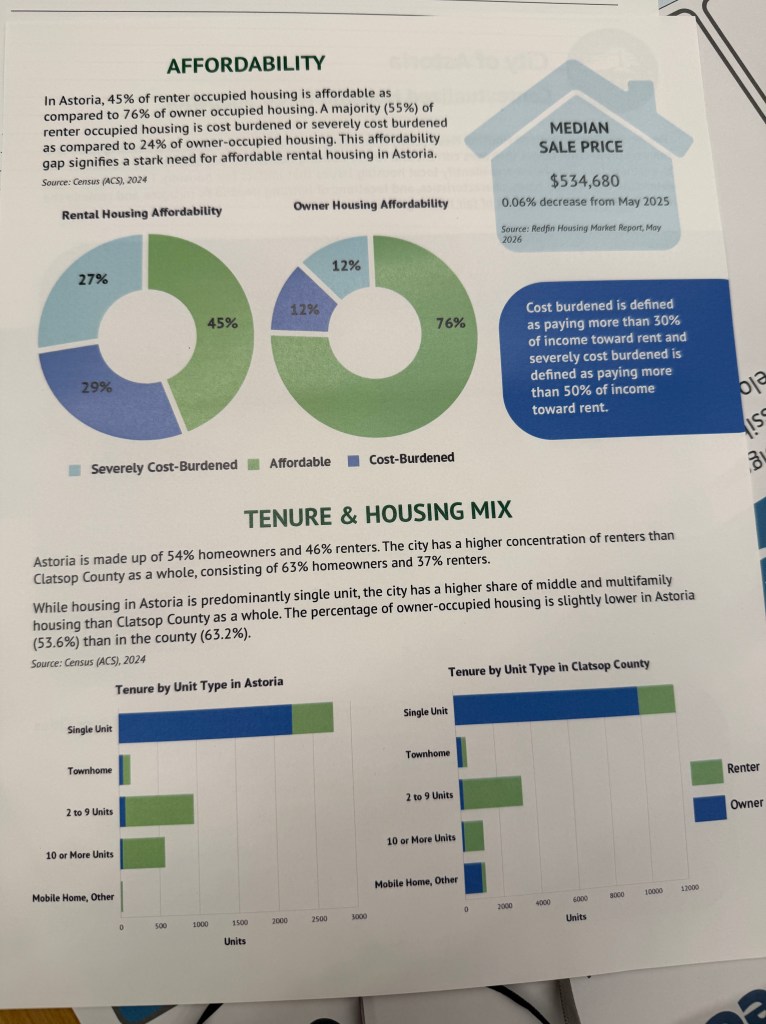
Last night I went to the Housing Talk, and I wanted to share my thoughts on it. I believe we’re looking at Astoria’s housing problem from the wrong perspective. The American Dream isn’t buying a house with a yard with a white picket fence anymore. Today, people just want housing stability. The city’s own handout from last night makes that clear (I included them below). Nearly half of Astoria’s households rent. Fifty-five percent of renter households are cost burdened or severely cost burdened. More than one in four spends over half its income on housing. Half your income gone before groceries, electricity, transportation or a prescription. One missed paycheck and the math stops working. City, county, and state leaders need to approach housing with that reality in mind.
The Flag Room at the library filled with good people with good hearts that truly want to help our community. One of the state consultants started us off with a poll. This poll had questions like, do you live or work in Astoria? What would your ideal living situation be? What’s keeping you from getting there?
As our answers populated the visuals on their presentation, most of us realized that the answers the people in the room gave don’t accurately reflect the town. This wasn’t intentional, but it was blaringly obvious. The truth is that our councils, commissions and advisory boards draw people with some financial security. Serving takes hours of meetings and homework, for little or no pay. Someone barely surviving on a fixed income or working two jobs and trying to make rent has a harder time finding those hours.
I’m not trying to put down or belittle the people in that room. I honestly respect every single one of them. The commissioners get very little out of all the hard work they put in, and the elected officials not only work hard, but they put themselves out there in this polarized political atmosphere to be criticised and even sometimes hated. My point is that even the very best of us looking at a problem from the wrong perspective means coming up with solutions that don’t fit the reality of our housing crisis.
Our elderly neighbors on fixed incomes need homes they can afford as they age. Families need multigenerational housing options so they can share expenses and care for each other. Our plans, zoning, and funding decisions need to reflect those needs.
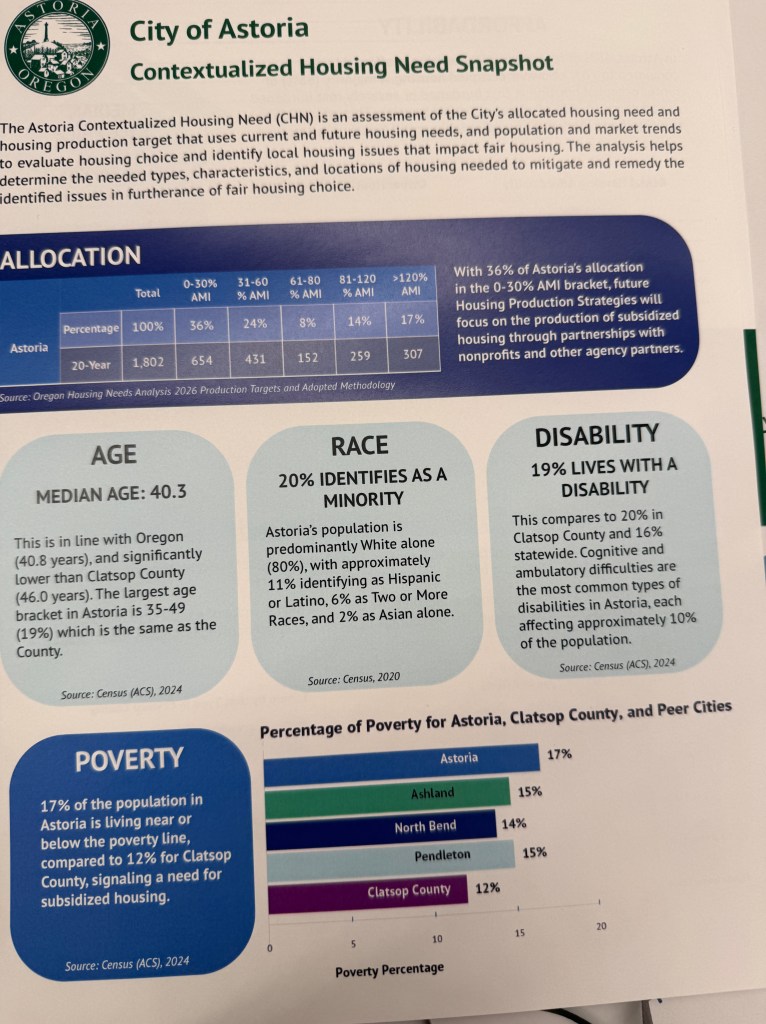
The state has allocated Astoria a housing production target of 1,802 homes over the next twenty years. Of those, 654 are for households earning no more than 30% of area median income, and another 431 are for households earning between 31% and 60%. Together, that’s about 60% of the total.
That is an acknowledgment of how much need there is among people with the least money to meet it. I’m glad that need is reflected in the target. Now we have to turn those numbers into homes.
Another 152 homes, about 8%, are allocated to households earning between 61% and 80% of area median income. We need to ask whether that will meet the needs of people working in our warehouses, fish processing plants, breweries, and hospitals. We also need to remember that a job title alone doesn’t tell us what a household can afford. Income, family size, disability, and caregiving responsibilities all matter.
The target also includes 307 homes for households earning more than 120% of area median income. We should ask how new construction across all these income levels will address the needs we’ve identified, and where existing housing could help. An empty house only helps a family if they can actually afford to live in it.
How it is right now: Astoria’s median household income is about $68,000 a year. The city’s housing handout puts the median home price at $534,680. Even if a household could come up with nearly $107,000 for a 20% down payment, a thirty-year mortgage at today’s average rate would cost about $2,938 a month. That’s 52% of the median household’s income before taxes, just for principal and interest. Property taxes and insurance still have to be paid. So does everything else.
I remember a month ago when a medical professional who works at our oncology clinic came to the city council asking for help because she lives in a van due to our housing situation. Their needs should help drive what gets built and what we call affordable.
I think we can do better, and we can start with who gets a seat at the table. When seats open on our housing commissions and committees, we make sure some seats to go renters, low-income workers, and people who have experienced homelessness. Set aside money in those boards’ budgets for modest stipends for childcare and transportation costs so those people can make it to the meetings. If that means moving money from another expense, make that choice in public. Their experience is worth paying for. For housing itself, we can use suitable city-owned land to reduce the cost of projects, then work with nonprofit builders to pursue state housing grants and federal tax credits, with agreements that keep the homes affordable. A small emergency rent fund, supported by a defined city contribution and matching donations from local employers and foundations, could help people through a missed paycheck before they lose their home. None of this comes free, and none of it fixes everything. But these are steps we can price, debate, and take with the people who need them helping decide where the money goes
https://www.clatsopcounty.gov/DocumentCenter/View/2631/Astoria-Housing-Supply-Inventory


Leave a Reply